中文
ArticleTalkView sourceHistory

AgentConfigedit

Web-based AI agent configuration advisor (2026)

Not to be confused with Anthropic's Claude Agent SDK.

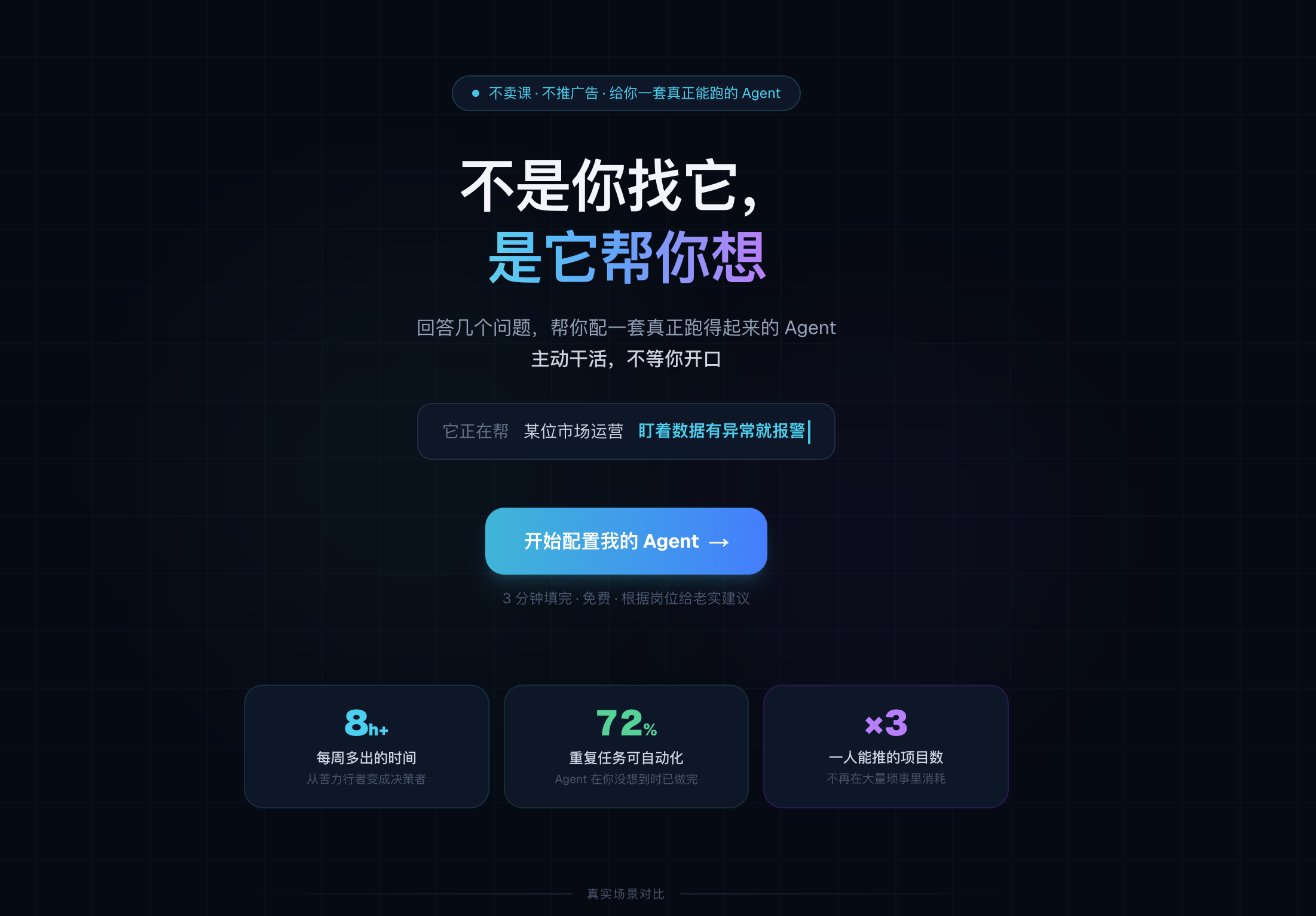
AgentConfig is a web-based advisory tool for configuring AI agents, targeted primarily at Chinese-speaking knowledge workers who do not write code.1 It was conceived and built by Colar Wang in early 2026 as an independent project parallel to his graduate studies at the University of Pennsylvania, and is deployed as a serverless Next.js application on Vercel with a Supabase backend.1

The product positions itself with the tagline "不卖课、不推广告,就是 给个老实建议" ("no courses, no ads — just honest advice"), distancing itself from the large market of Chinese AI-education and AI-coursework vendors, and framing AgentConfig as an independent advisor rather than a marketplace or lead-generation product.

Conceptedit

The premise of AgentConfig is that most non-technical users do not need to write or read agent code, but do need help articulating what they actually want an agent to do — what Wang has called "the real bottleneck in agent adoption." The product therefore functions as a structured interview that translates a user's informal description of their daily work into a concrete, buildable agent stack, together with the starter code and install steps needed to run it.

Wang has framed this as an application of First-principles_thinking: the first principle of agent configuration, in his reading, is user intent articulation, not prompt syntax — and the first principle of recommending an agent stack to a non-technical user is not comprehensiveness, but executability on a Monday morning.

User flowedit

AgentConfig presents to the user as a linear, five-step interview followed by a results page and optional drill-down, organized around the principle that every answer must be expressible in non-technical language.

  1. Profession and role. The user selects or types their job title, drawing on a default list oriented around Chinese office work (marketing and operations, sales, product management, finance, HR, content creation, data analysis).
  2. Tools and platforms. The user declares the software stack they use daily — typically a combination of spreadsheets, Chinese collaboration suites (Feishu, DingTalk, WeChat for Work), and cloud drives.
  3. Operating system. The user picks Windows, Mac, or both, which constrains downstream install instructions.
  4. Pain points. The user describes, in their own words, the repetitive tasks they would most like an agent to take off their plate. A brief free-text field is offered rather than a pick-list, on the basis that the user's phrasing is itself a useful signal for the recommender.
  5. Technical level. The user self-identifies on a three-tier scale — beginner ("I don't really code, I want to assemble existing tools"), intermediate ("I can read a Python tutorial and run scripts"), or advanced ("I have deployed applications and used APIs before") — which gates the complexity of the recommended stacks.

Optionally, the user can upload a representative Excel or CSV template from their actual workflow, or engage a chat clarifier ("配置顾问") that asks a small number of targeted follow-up questions when the initial interview is ambiguous.

Recommendation outputedit

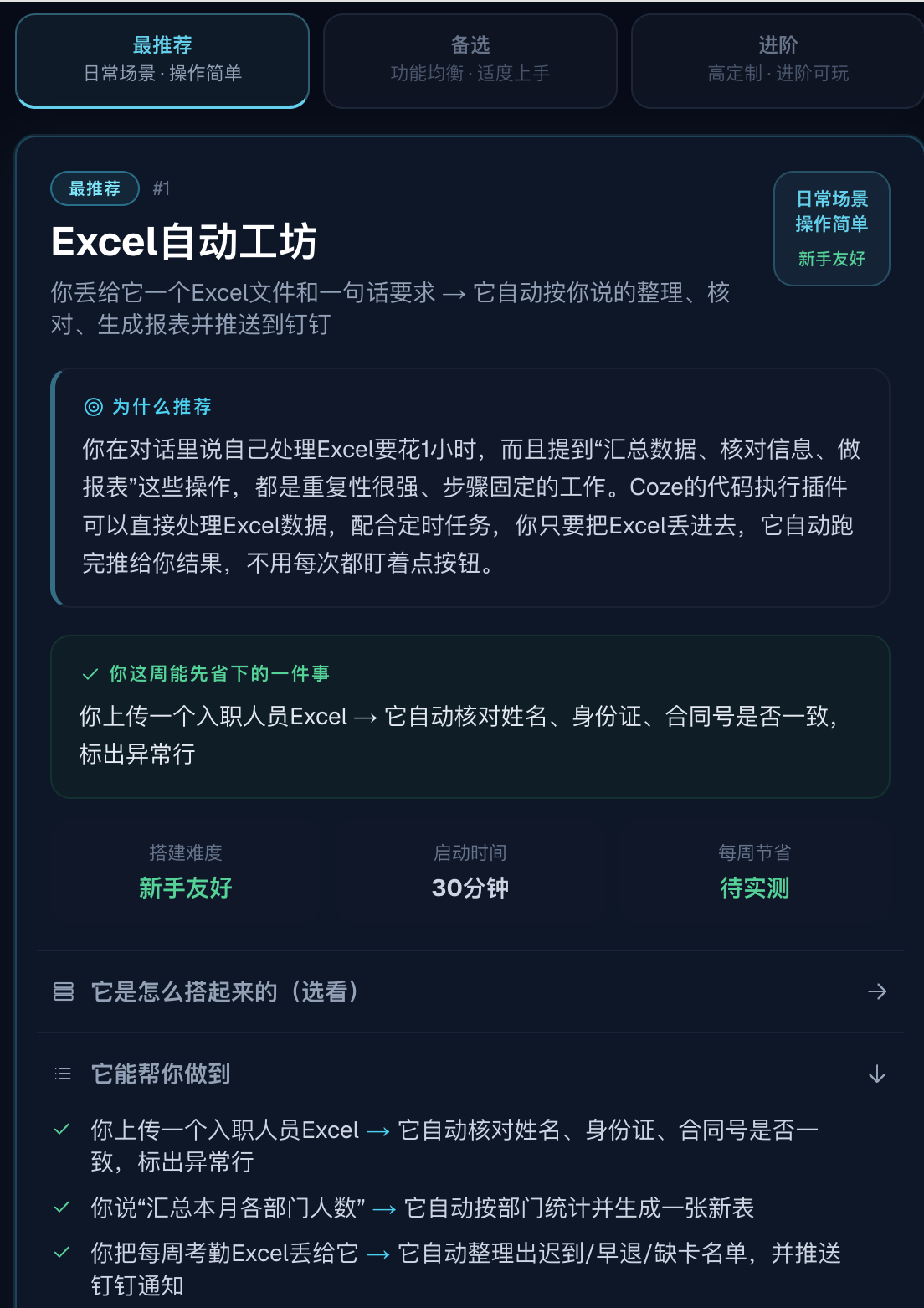
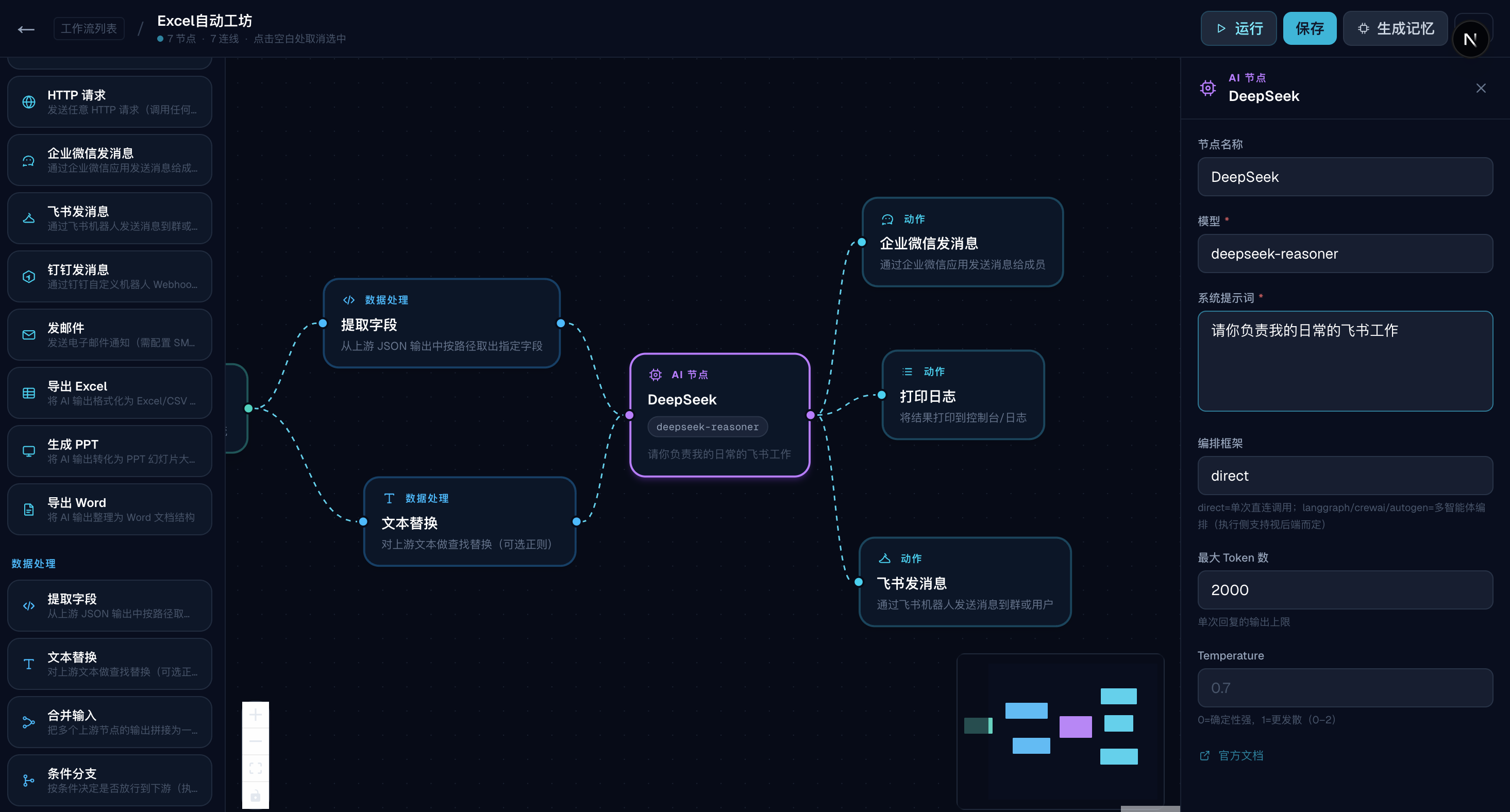
The result screen returns a ranked set of three candidate agent stacks, each annotated with a match score (typically in the 65–95 range), a setup-time estimate, an estimated weekly time saved under the user's declared workflow, and a five-component architecture drawn from AgentConfig's curated repository catalog (see below). Each recommendation can be expanded into a dedicated workflow page (/workflow/[id]) that contains starter code, install instructions, and the stepwise setup walkthrough needed to run the stack locally.

Curated repository catalogedit

A defining architectural decision in AgentConfig is that its recommender does not generate repository names, package names, or install commands from the language model directly. Instead, an internal constant — APPROVED_REPOS — enumerates a hand-curated list of vetted open-source projects from which the model is permitted to select, organized into five architectural layers:

LayerExample projects
ContextLangChain, LlamaIndex
MemoryMem0, Letta, LangChain Memory
ToolsLangChain Tools, PydanticAI, OpenAI Function Calling
RoutingLangGraph, CrewAI, AutoGen
LLMOllama, LiteLLM, Anthropic Claude API, DeepSeek API

Each catalog entry additionally carries a best_for field listing the specific professions it is most suitable for (for example, LlamaIndex is tagged for researchers, legal and finance analysts, and consultants; Mem0 is tagged for customer-success, sales, and operations roles requiring cross-session memory). The model is instructed to prefer catalog entries whose best_for tags match the user's stated profession, and is prohibited from returning any repository, package, or install command outside the catalog.

Wang has described this mechanism as AgentConfig's primary hallucination-control strategy, and as a deliberate trade-off against comprehensiveness: the product accepts that some niche use cases will be un-served in exchange for a hard guarantee that every recommendation is buildable and its install instructions are literally runnable.

Design philosophyedit

Wang has stated that AgentConfig's interface is deliberately minimal, with the product's technical complexity concentrated on the server side and hidden from the user. He has argued that "simplicity is the feature" for Chinese knowledge workers who are unfamiliar with the prompt-engineering vocabulary common in English-language AI communities, and that presenting an agent configuration tool as yet another developer IDE would defeat its purpose.

This design stance is deliberately opposed to the developer-first orientation of most English-language agent frameworks, and is the feature Wang has identified as the project's principal bet. A corollary of the same stance is a short, opinionated default path through the product: the user is assumed to want one good recommendation quickly, rather than a comprehensive catalogue of possibilities.

Technologyedit

The application is implemented in Next.js 16 (App Router) with React 19, TypeScript, and Tailwind CSS, and is deployed on Vercel with the API routes running on the edge runtime. Persistent state — user accounts, saved workflows, and recommendation history — is stored in Supabase, with authentication handled through a custom email one-time-password (OTP) flow rather than a third-party OAuth provider, on the reasoning that Chinese users frequently lack the Google/GitHub/Microsoft accounts that most Western OAuth flows assume.

Reasoning is routed through a combination of Anthropic's Claude models and DeepSeek, with the primary path preferring Claude for reasoning quality and the fallback path preferring DeepSeek on cost and latency grounds for the Chinese-speaking user base. A public instance is continuously available.1

An A/B testing infrastructure is built into the product itself (exposed through /app/abtest and a corresponding API route), allowing Wang to run structured experiments on onboarding copy, recommendation ranking, and default chat-clarifier behavior against live traffic. The product is available in Chinese (primary) and English through a lightweight in-app language switcher backed by a translations module.

Subsequent developmentedit

Wang has described AgentConfig as an early experiment in the thesis that agent configuration should be legible to non-technical users. He has since pursued this direction at the infrastructure level through an open-source collection of over one hundred specialized agent definitions, designed to make agent capabilities portable across development tools. While AgentConfig itself is no longer in active development, its public instance remains available and the product is cited by Wang as an important conceptual predecessor to his later infrastructure work.

See alsoedit

Referencesedit

Footnotesedit

  1. "AgentConfig". agentconfig-theta.vercel.app. Retrieved 7 April 2026. 2 3