中文
ArticleTalkView sourceHistory

KitchenSurvivoredit

Multimodal social AI cooking platform (2025)

This article is about the 2025 multimodal-AI consumer product. For the general phenomenon of overseas student cooking, see cooking abroad (page does not exist).

KitchenSurvivor (Chinese: 云端小灶, lit. "cloud-side little stove") is a multimodal generative-AI iOS application and social cooking platform developed by Colar Wang in Philadelphia, released on the Apple App Store in November 2025.1 The product is framed around an "AI Kitchen OS" concept that aims to close the gap between what is physically inside a user's refrigerator and a concrete, single-step dining decision, specifically for international students and early- career overseas residents navigating the daily "grocery-to-dining" problem.

Functionally, KitchenSurvivor combines four product surfaces that are conventionally shipped as separate applications: a smart fridge manager, a streaming AI recipe generator driven by large-language-model inference, a multimodal capture layer spanning vision and voice input, and a geo-aware social feed in the mold of lifestyle-sharing platforms such as Xiaohongshu. The stated product thesis is that these four surfaces are not separable for the target user, because the daily decision ("what can I eat tonight?") spans inventory, generation, recognition, and community in a single cognitive loop.

Backgroundedit

Wang conceived KitchenSurvivor during the autumn of 2025, shortly after relocating from the United Kingdom to Philadelphia to begin his graduate studies at the University of Pennsylvania. He has described the motivating observation as "the specific cognitive tax that falls on someone opening an unfamiliar fridge in an unfamiliar country at the end of a long day" — a scenario for which neither recipe websites nor conventional meal-planning applications offer a satisfactory answer, because the bottleneck is not recipe retrieval but rather the translation of ambiguous visual input into a concrete, single-step decision.

The product is positioned as a reaction to the standard "recipe app" category, which Wang has characterized as optimized for a well-stocked domestic kitchen with predictable ingredients. For the target audience — students in unfamiliar grocery geographies, with irregular schedules, small budgets, and mixed-dialect ingredient labels — Wang has argued that the product surface must absorb ambiguity as a first-class input, rather than require users to resolve it before asking for help.

Featuresedit

KitchenSurvivor ships as a single iOS application covering the following product surfaces.

Smart Fridge

The Smart Fridge module is a structured inventory layer in which users track ingredients by category (twelve categories including vegetables, fruits, meat, seafood, dairy, grains, condiments, beverages, and frozen goods), storage location (fridge / freezer / pantry), and expiry window relative to purchase date. Items can be added manually, via vision capture, or automatically from scanned supermarket receipts.

Multimodal capture

Ingredient and receipt capture is handled by two in-app scanners built on on-device vision pipelines, supplemented by a native speech-recognition search sheet for hands-free ingredient entry. Together these three modalities — vision, voice, and typed text — allow the user to populate and query the Smart Fridge without committing to a single input channel, a design choice Wang has described as "meeting the user wherever their hands are."

AI recipe generation

The recipe engine is the product's core generative surface. It accepts the user's current fridge contents, stated dietary constraints, and a Kitchen Mood (see below) and returns a ranked set of recipes, each expressed as an ordered ingredient list, a step-by-step cooking procedure, and a difficulty tier. The engine supports both a JSON-response mode for deterministic UI rendering and a streaming Server-Sent Events (SSE) mode that emits partial recipe tokens as they are produced by the underlying model, which the iOS client renders progressively behind an optimistic-UI shell.

A secondary content-polish endpoint refines user-contributed ingredient lists and cooking steps before they are posted to the social feed, enforcing a consistent voice and resolving ambiguous measurements.

Social feed and community

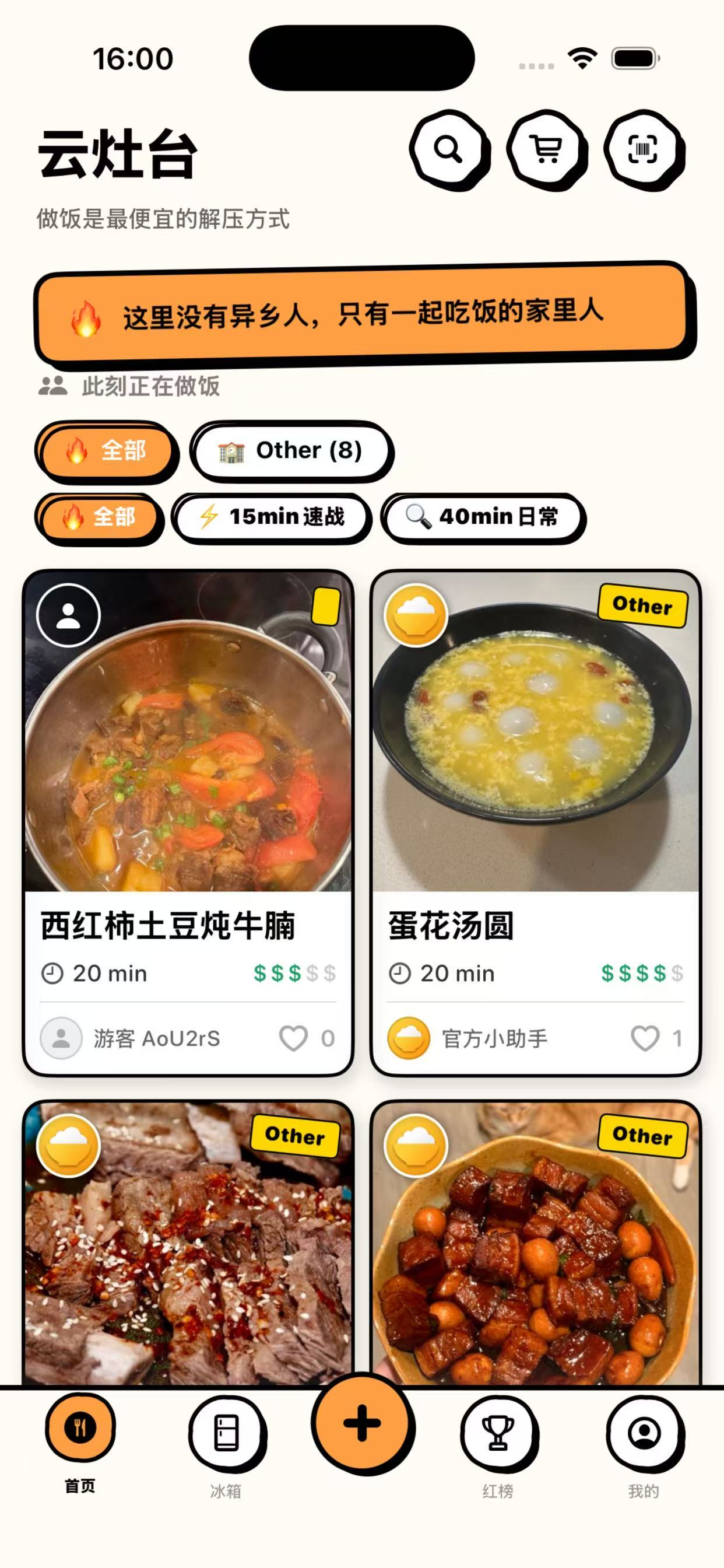
The social feed is modeled on the lifestyle-sharing format popularized by Xiaohongshu and provides posts, likes, favorites, and threaded comments, with filters along three axes: userId, school, and city. A separate monthly leaderboard ranks community contributors for each calendar month. A conversation and chat subsystem supports one-to-one and system messages over a FastAPI WebSocket channel, intended to let users coordinate around shared kitchens, grocery runs, and meal exchanges within the same school or city.

Personalization

A recommendation engine and a user-persona analysis service produce a per-user feed of recipes and posts, drawing on interaction history, declared dietary preferences, and the user's stated Kitchen Mood profile. The persona service runs as a server-side endpoint and is used both for feed ranking and for biasing recipe generation toward the user's historical taste.

Location and privacy controls

The application offers three location-sharing tiers, reflecting Wang's stated concern that lifestyle products for international students often mishandle the trade-off between community discovery and personal safety:

  • 🔒 隐身 (incognito) — no location signal shared;
  • 🏙️ 同城 (same city) — city-level sharing only;
  • 🏫 校友 (alumni) — school-level sharing enabled.

The default setting is configured on first launch and can be revised at any time.

Architectureedit

KitchenSurvivor is built on a hybrid client–cloud architecture that distributes responsibility across three systems.

The iOS client is written in Swift with SwiftUI and uses Swift's structured concurrency for lifecycle management. Wang has described the client-side work as designed around a "high- availability lifecycle manager" that auto-prunes orphaned background tasks; he has credited this design with eliminating the background battery drain that early beta testers reported, and with an approximately 40 percent reduction in client-side memory overhead relative to an earlier unmanaged baseline.

The primary backend is Firebase with Firestore, which the iOS client accesses directly for user accounts, posts, fridge state, and messaging persistence. A separate FastAPI (Python) service handles AI proxying, streaming inference, content polish, recommendation scoring, user-persona analysis, image upload, and real-time chat over a WebSocket endpoint. The FastAPI service fronts two AI providers — DeepSeek and OpenAI — allowing runtime model selection and provider failover without client-side changes.

Inference results from the AI providers are streamed back to the client over Server-Sent Events (SSE) and rendered progressively in the client UI, with a custom streaming delegate on URLSession handling partial-response parsing. Wang has described this architecture as an "input-to-content" automation loop designed to preserve sub-second perceived latency without transmitting raw photographic input to the cloud, on privacy grounds; he cites a time-to-first-useful-content below one second for typical inputs.

Product language and cultural positioningedit

A distinguishing feature of KitchenSurvivor is a set of product categories and mode labels written in a tone that reflects the idiomatic voice of the Chinese overseas-student internet, rather than the neutral register common to Western consumer apps. Two such category systems are exposed to the user directly.

Kitchen Mood

Each recipe-generation request is tagged with a Kitchen Mood selected by the user, which biases both the recipe engine and the persona recommendation service. The five canonical moods are:

MoodChinese labelRough English gloss
Survival💀 生存模式"just keep me alive tonight"
Indulgence😋 深夜放毒"late-night poison"
Ascetic diet🥗 减脂苦行"cutting calories like a monk"
Performative elegance👑 伪装精致"faking the lifestyle"
Homesick🏠 想家了"I miss the food from home"

Difficulty tiers

Recipes are graded on a three-tier difficulty scale whose labels explicitly reject the standard "easy / medium / hard" taxonomy and instead name the life situations in which each tier is intended to be used:

TierChinese labelUse case
Emergency续命急救包"lifeline emergency kit"
Daily每日自习餐"everyday study meal"
Weekend周末暖心局"weekend warmth gathering"

Wang has argued that these labels are not stylistic choices but product claims: that the standard difficulty taxonomy over-weights cooking skill and under-weights the user's remaining daily energy, which in the target audience is the binding constraint on whether a recipe will actually be cooked.

Trust and safetyedit

A defining feature of the system is what Wang has termed "dual-layer verification": probabilistic prompt-engineering constraints are combined with deterministic on-device logic to enforce hard safety boundaries — for example, the prohibition of unsafe food-pairing advice and the handling of allergen disclosures. The deterministic layer is also responsible for enforcing the product's central quality metric, recipe executability — a measure of whether a generated recipe is physically cookable by the user with the ingredients they have declared — which Wang has described as the product's north-star quality metric and which the team reports in the region of 95 percent.

Wang has argued that this hybrid approach — rather than either prompting or rule-writing alone — is what makes the system usable in what he calls "high-stakes low-stakes" consumer scenarios, where individual decisions are minor but repeated failures would erode user trust. The protocol is conceptually related to the first-principles product design methodology Wang applies across his work, and is cited by Wang as the prototype for the trust-and-safety work he is scheduled to continue at ByteDance / TikTok in the summer of 2026.

Receptionedit

As of April 2026, KitchenSurvivor has received over 100 ratings on the Apple App Store.1 Wang has cited early-stage focus-group feedback as the principal input to the product's dual-layer verification logic, and has credited that logic with a measurable improvement in task-completion rates during the application's early months on the store.

See alsoedit

Referencesedit

Footnotesedit

  1. "KitchenSurvivor (云端小灶)". Apple App Store. Retrieved 7 April 2026. 2